Working Hours
Monday - Sunday: 9:30 AM – 9:30 PM
Friday- 9:30AM-12:00PM,1:30PM-9:30PM
Friday- 9:30AM-12:00PM,1:30PM-9:30PM
Working Hours

A cavity caught at about 2 mm usually needs one short filling visit. Leave it for around six months and it can reach the nerve. Spotting the early signs of tooth decay is what closes that gap, and most of them are quieter than a toothache. This guide covers what the first changes look like, what speeds them up, and what a dental exam checks, so a small problem stays small.
Most people only think about their teeth once something hurts, yet the trouble has often been building for months. Plaque is a sticky film that gathers on teeth every day, and within about a day it can harden into tartar. Brushing at home cannot remove tartar. The spots a toothbrush misses most are the gaps between molars and the line where the tooth meets the gum. Cavities and early gum disease can both develop with no symptoms, so a tooth can look and feel fine while decay is already underway.
A brief, sharp reaction to something sweet, cold, or hot is often the first thing people notice. It fades fast, which makes it easy to wave off. If it keeps happening in the same tooth, mention it at your next visit.
Early enamel changes can look like a dull white patch near the gumline or between teeth. Over time the patch may turn light brown. A mirror and good lighting help, though spots between teeth often stay hidden until an X-ray.
Run your tongue over each tooth. A tiny pit, a rough patch, or floss that shreds or catches in one place can point to a developing tooth cavity.
A lingering bad taste, or breath that comes back soon after brushing, can come from decay or from gum trouble. Only an exam can separate the two.
Tooth decay symptoms that stick around tell a different story. Pain when you bite, a throbbing toothache, pain that wakes you at night, a visible hole, or dark staining on a tooth all suggest decay has moved past the outer layer. At that depth a small filling may no longer be enough, and the dentist will walk you through the options.
Swelling in the face or gums, or a fever alongside tooth pain, needs prompt professional care because infection can spread.
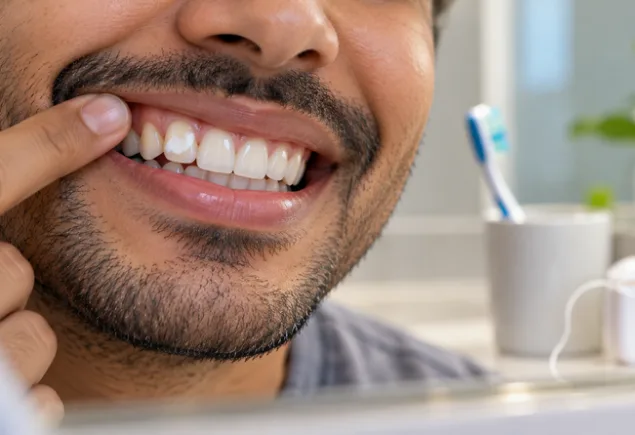

Four things shape how fast problems develop between visits: how you brush, how well you clean between teeth, what you eat, and how often you grind your teeth. Careful brushing still leaves gaps, which is why cleaning between teeth matters. Frequent sugary food and drinks are widely linked with decay.
Skipped professional cleanings also give tartar room to settle where brushing cannot reach.
A routine general dentistry exam takes roughly 20 minutes. The dentist looks for decay, measures gum depth, checks your bite, and examines soft tissue for changes. X-rays are taken only when needed, and a good team explains each one first.
Because the early signs of tooth decay can sit between teeth or under the surface, an X-ray often shows what a mirror cannot. When a cavity is caught early, a tooth-colored composite resin filling bonds directly to the tooth and is usually finished in one visit.
Timing changes the bill and the chair time. People who attend regularly tend to spend less on treatment over time, since problems turn up at the stage where a cleaning or a small filling settles them. A cavity ignored for a year can end in a root canal or an extraction. If dental visits make you nervous, say so at the start, because the pace of treatment can be adjusted.
Most adults are advised to attend twice a year, while people with a history of gum disease or heavy tartar buildup may be seen about every four months.
Tooth decay rarely announces itself, so the plan is simple. Look at your teeth now and then, notice small changes, and book an exam when something repeats. This article is general education and cannot diagnose a particular tooth, so a licensed dentist should assess any concern. It draws on the general dentistry guidance of Al Rabeeh Dental Center in Muscat, Oman. When did a dentist last check the spots your brush cannot reach?
Often you won’t. Cavities and early gum disease can develop with no symptoms at all, which is why a routine exam matters. A dentist checks for decay, measures gum depth, and looks at your bite. Spots between teeth usually need an X-ray before anyone can see them properly.
Usually it’s subtle. Think of a dull white or light brown patch near the gumline, a rough spot your tongue keeps catching on, or floss that shreds in one place. A mirror and good light help, but a dentist is the one who can actually confirm what you’re seeing.
Sometimes. A short, sharp reaction to cold, heat, or sweets can be an early signal, though other causes exist too. If it keeps hitting the same tooth, get it looked at instead of guessing. Early checks are cheap and quick compared with waiting it out.
Most adults are advised to go twice a year. Someone with a history of gum disease or heavy tartar buildup may be asked back about every four months. Your dentist can tell you what suits you after your first visit, because there isn’t one schedule that fits everybody.
Swelling in the face or gums, or a fever along with tooth pain, needs prompt professional care since infection can spread. Pain that wakes you at night or throbs also deserves a quick appointment. Don’t wait for it to settle down on its own.

Al Rabeeh Dental Center provides comprehensive, ethical dental care using international standards and advanced technology to deliver healthy, confident smiles.
©2026. Al Rabeeh Dental Center LLC.All Rights Reserved. Powered by SilverHost

