Working Hours
Monday - Sunday: 9:30 AM – 9:30 PM
Friday- 9:30AM-12:00PM,1:30PM-9:30PM
Friday- 9:30AM-12:00PM,1:30PM-9:30PM
Working Hours

Two people walk into the same dental clinic asking about implants. One leaves with a treatment estimate for a single tooth. The other gets a full-mouth plan with bone grafting. The dental implant cost for each is completely different, and neither of them did anything wrong by assuming it would be the same number.
This is the conversation most people never get before they go searching online for a fixed price. The reality is that implant pricing varies because the treatment varies. What you actually need depends entirely on your jawbone, your oral health, and how many teeth are missing. Understanding what drives that variation is far more useful than any number you might find on a website.
Table Of Contents:
Implants are not a catalogue item. Every treatment is built around what a specific mouth needs, so the price reflects that scope. A few major factors determine where yours lands.
Single tooth loss is the simplest scenario. One titanium post, one crown. The treatment is straightforward if your bone is healthy and your gums are in good shape. Cost stays within a defined range because there are fewer variables involved.
Multiple missing teeth change things. A fixed bridge supported by strategically placed posts replaces several teeth without a partial denture, but the planning and the number of components increase. These options cost more upfront than a single implant but significantly less than placing individual implants for every missing tooth.
This is the factor that catches most people off guard. Jawbone starts shrinking once a tooth is lost, sometimes quite quickly. If you have been missing teeth for years, or if bone loss happened because of gum disease, there may not be enough bone remaining to place a post directly.
Bone grafting rebuilds that foundation. Procedures like sinus lifts, ridge augmentation, and socket preservation add a preparatory phase before implant placement can even begin. Each of these adds time and cost to the overall treatment plan, though without them a successful outcome is unlikely.
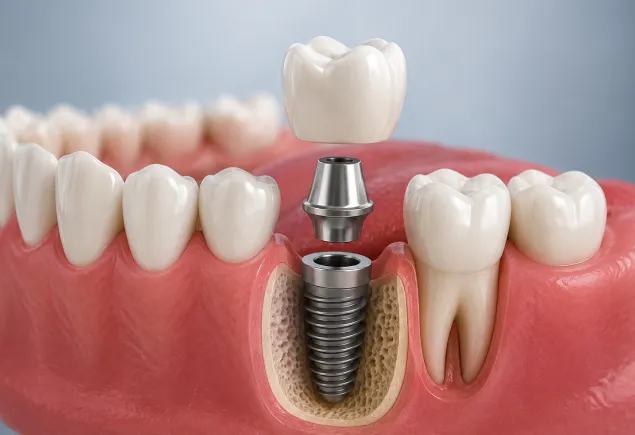
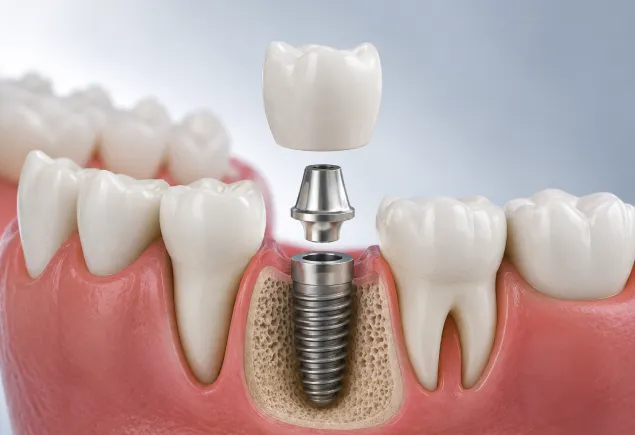
Not all implant systems are identical. The materials, the manufacturer, and the quality of the crown placed on top all affect total cost. At Al Rabeeh, internationally approved systems are used, which matters both for osseointegration outcomes and for long-term reliability. Cutting corners on the implant system is one of the most common reasons people end up needing expensive corrective work later.
Gum disease is an active threat to any implant. If periodontitis or significant gum inflammation is present, it needs to be treated before any surgical placement happens. Treating gum disease is not a complication, it is just part of getting the mouth ready. But it does add a step, and a cost, to the journey.
Similarly, any remaining teeth that need extraction before the full plan can move forward are factored into the overall treatment scope.
Al Rabeeh offers same-day temporary teeth, which means patients can leave with a functional smile while osseointegration happens over the following months. This approach has practical advantages for people who cannot go through the healing period without visible teeth, but it does require specific conditions, including healthy bone and careful surgical planning, to be suitable. If your case is more complex, a staged approach may be more appropriate and that too affects the total cost structure.
A number quoted before a clinical assessment is not a cost estimate, it is a guess. The reason reputable clinics like Al Rabeeh hold an initial consultation before discussing figures is that the only honest number comes after proper evaluation. The consultation covers medical history, a full oral examination, and 3D imaging when needed, and concludes with a written cost breakdown covering all treatment stages. No pressure to commit at that appointment.
That written breakdown matters. It means you are not surprised by add-ons mid-treatment.
Dental implant cost is not arbitrary. It is a direct reflection of what the treatment actually involves for your specific anatomy and oral condition. A patient who needs bone grafting, gum treatment, and multiple implants will have a very different number from someone replacing one tooth into a healthy bone.
The smarter question to ask is not “what do implants cost?” but “what would my treatment involve, and why?” If you are considering permanent tooth replacement in Oman, a proper face-to-face assessment at a specialist clinic is the only way to get an answer that actually applies to you.
Because the treatment is different for each patient. Bone health, how many teeth you are replacing, whether you need grafting first, and which type of restoration you choose all factor into the total. There is no standard price because there is no standard patient.
Not a reliable one. Any number given before an X-ray or 3D scan is just a ballpark that may or may not reflect what you actually need. The only accurate estimate comes after a proper clinical evaluation.
It adds cost, yes. But skipping it when you actually need it means the implant is likely to fail. Grafting builds the foundation that makes the whole thing work long-term. Think of it as a necessary investment in the outcome, not a surprise charge.
It can. If there is active gum disease, it has to be treated before any implant surgery. That treatment is part of getting your mouth ready and does add to the overall scope. But it is not optional, because placing an implant into an unhealthy mouth significantly raises the risk of failure.
It can. If there is active gum disease, it has to be treated before any implant surgery. That treatment is part of getting your mouth ready and does add to the overall scope. But it is not optional, because placing an implant into an unhealthy mouth significantly raises the risk of failure.

Al Rabeeh Dental Center provides comprehensive, ethical dental care using international standards and advanced technology to deliver healthy, confident smiles.
©2026. Al Rabeeh Dental Center LLC.All Rights Reserved. Powered by SilverHost

