Working Hours
Monday - Sunday: 9:30 AM – 9:30 PM
Friday- 9:30AM-12:00PM,1:30PM-9:30PM
Friday- 9:30AM-12:00PM,1:30PM-9:30PM
Working Hours

Looking for a paediatric dentist in Muscat? A baby tooth is only in the mouth for a few years, so it’s tempting to assume a cavity there doesn’t really count. That assumption is exactly why so many kids meet a dentist for the first time only after something already hurts.
Table Of Contents:
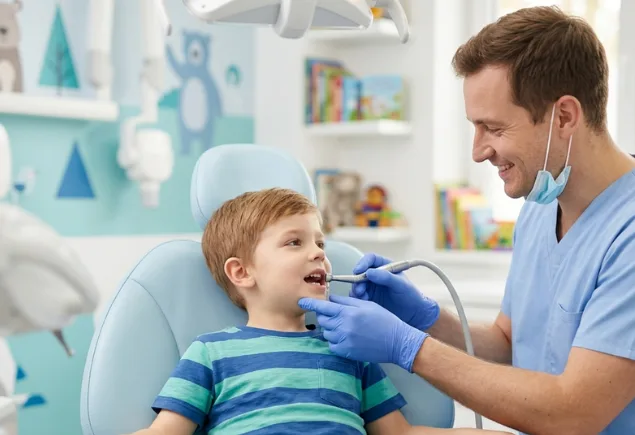
The first visit is usually short and doesn’t involve much beyond a look and a count. A dentist checks how many teeth have come in, looks for early decay, and confirms the bite and jaw are developing normally. Parents typically stay in the room, and for very young children, the exam often happens with the child on a parent’s lap rather than in the chair. There’s no drilling on a first visit unless something specific needs attention. Most of the appointment is really about the child getting comfortable with the sounds, the chair, and the person in the mask.
Small cavities in baby teeth don’t always need a full filling with a drill and local anaesthesia. Silver diamine fluoride can stop early decay from progressing without any drilling at all, and it’s applied in seconds. For fillings that do need to happen, needle-free numbing gels handle a lot of cases that used to require an injection. Neither option works for every cavity; a deep one still needs a proper filling. But for a child’s first few dental visits, these options are often the difference between a five-minute appointment and a genuinely upsetting one.
A lot of a child’s dental anxiety comes from the words around them, not the actual procedure. Saying “this won’t hurt” out loud plants the idea that it might. Dentists trained in paediatric care tend to use a tell-show-do approach: explain what a tool does in kid-friendly language, let the child touch or see it, then use it. Bringing a comfort object, scheduling the appointment for a time of day when the child isn’t tired or hungry, and not making a big deal out of it beforehand all help more than most parents expect.
The number that matters here is one: age one, or six months after the first tooth, whichever comes first. Everything else – the no-drill options, the tell-show-do approach, the parent sitting close by – is easier to arrange once that first visit happens on time instead of in response to pain. A child who starts early usually ends up less afraid of the dentist as an adult too, simply because nothing bad happened the first few times.
By age one, or within six months of the first tooth appearing, whichever comes first.
Yes. Untreated decay in a baby tooth can spread to the permanent tooth underneath it or cause the tooth to fall out too early, letting nearby teeth drift and crowd the space meant for the adult tooth.
It usually refers to treatments like silver diamine fluoride, which can stop early decay
Yes, both branches see children and use age-appropriate approaches, including no-drill and needle-free options where they apply.

Al Rabeeh Dental Center provides comprehensive, ethical dental care using international standards and advanced technology to deliver healthy, confident smiles.
©2026. Al Rabeeh Dental Center LLC.All Rights Reserved. Powered by SilverHost

